



ROG Xbox AllyXBOX

Tenebris Somnia Review—A Nightmare Caught Between Pixels and Reality

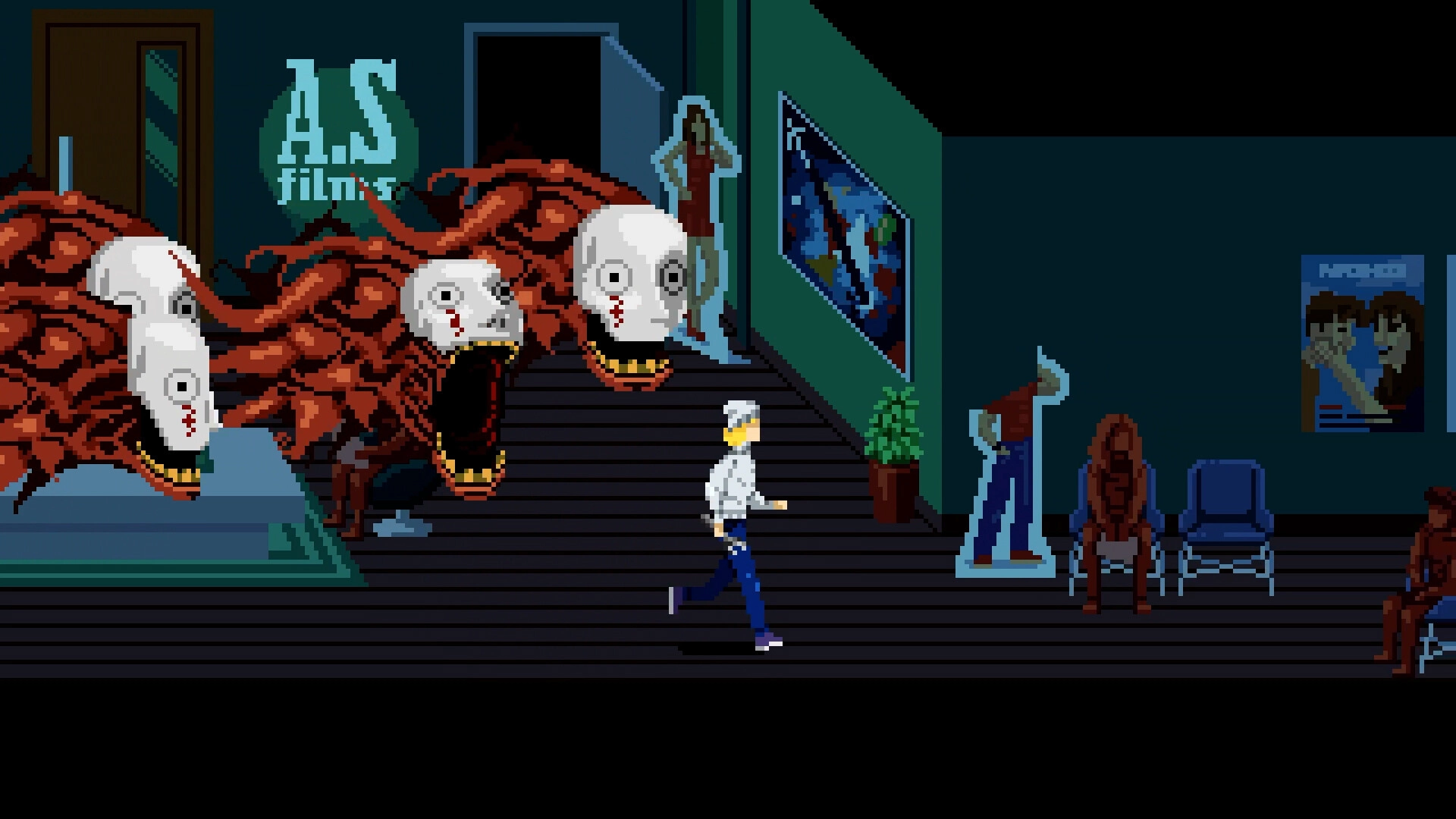
The collision between old-school pixel art and live-action horror is what first drew me to Tenebris Somnia, and it proves to be far more than a clever gimmick. Its chunky sprites and side-on environments recall an era when horror games found terror in dark corridors and limited resources, while its filmed cutscenes introduce something altogether more disturbing: real actors, practical effects and creatures that feel uncomfortably tangible. The contrast is striking, but what makes it so effective is the way these two visual languages complement one another. By moving between the artificial and the real, Tenebris Somnia finds fresh ways to unsettle, turning nostalgia into something genuinely nightmarish.

Release Date: October 16th 2026
Developer: Saibot Studios, Andrés Borghi
Publisher: New Blood Interactive
Price: £20.99/ $24.99 USD
Reviewed On: Xbox Series S / ROG Xbox Ally
* Access Provided For Review *

More Details

Julia is haunted by recurring dreams in which her former boyfriend, Ivan, is attacked by monstrous creatures. Seeking answers, she visits his apartment, only to find herself drawn into a mystery that becomes increasingly sinister. What begins as a personal search soon opens onto something stranger, blending relationship troubles and unresolved feelings with supernatural horror. The premise might sound familiar, but the game handles its mystery with enough intrigue to keep the story compelling. Beneath the grotesque imagery lies a more intimate anxiety about the past, and the difficulty of separating our memories from the things we would rather forget.

Exploration follows the traditions of classic survival horror, sending Julia through interconnected environments in search of useful objects, clues and routes forward. The side-on perspective gives the world a wonderfully old-fashioned character, while its compact spaces reward careful observation. Ordinary objects can acquire unexpected significance, and progress depends on paying attention to the details that others might overlook. There is a satisfying deliberateness to the process, a sense that every discovery has been earned rather than handed to you. In an era when games are often eager to guide players towards their next objective, Tenebris Somnia trusts the pleasure of figuring things out for yourself.

Its puzzles build on that philosophy, often requiring you to connect seemingly unrelated clues or reconsider the purpose of something encountered earlier. The solutions can be wonderfully satisfying, particularly when they emerge naturally from the game’s environments and unsettling logic. There are moments when the lack of direction threatens to become frustrating, but these are outweighed by the pleasure of making a breakthrough. More importantly, the puzzles contribute to the atmosphere rather than existing as distractions from it. The world feels like a place governed by its own peculiar rules, and understanding those rules becomes part of the horror.

Combat provides a welcome counterpoint to the slower rhythm of exploration. Resources are limited, creatures pose a genuine threat, and encounters encourage you to consider whether fighting is worth the cost. The mechanics deliberately recall older survival horror games, where vulnerability was an essential part of the experience rather than an inconvenience to be overcome. There is an occasional awkwardness to the fighting, but it rarely undermines the larger achievement. Tenebris Somnia understands that horror depends on uncertainty, and its most effective encounters leave you wondering whether survival is worth the resources required to achieve it.

The game’s defining achievement is its extraordinary combination of pixel art and live-action cutscenes. What initially appears to be an unlikely marriage of two mediums becomes the foundation for an unusually effective approach to horror. The transition from a simplified digital world to recognisable human faces and physical spaces is inherently disquieting, forcing you to reconsider what you have just seen. Familiar locations take on a new significance when presented through a live-action lens, and the contrast makes the imagined horrors feel suddenly, alarmingly real. Rather than simply borrowing the appearance of classic horror games, Tenebris Somnia uses their limitations to create something entirely its own.

The practical effects make the most of that contrast. Its creatures possess a tangible, almost unpleasant physicality, their presence enhanced by the knowledge that they have been brought to life through real-world filmmaking rather than pixels alone. These sequences could easily have felt like an interruption to the game, but instead they deepen its atmosphere and give its more abstract horrors a disturbing immediacy. The relationship between the two styles is continually fascinating, each making the other feel less familiar. There is an infectious sense of experimentation here, and the confidence to pursue an idea this unusual is part of what makes Tenebris Somnia so memorable.

Sound design is equally important to the experience, lending weight to the spaces between its visual shocks. Environmental noises and restrained musical cues establish a persistent sense of unease, allowing tension to build without constantly resorting to obvious scares. When the game does become more aggressive, the shift is all the more effective for the quiet that precedes it. The live-action sequences benefit particularly from this approach, with the physicality of their sound reinforcing the impression that something has crossed into the real world. Together, the audio and visuals create an atmosphere that lingers long after individual encounters have passed, making even the simplest stretch of exploration feel charged with possibility.

9
Verdict
Summary

Tenebris Somnia is a remarkable piece of horror craftsmanship, a game whose willingness to experiment produces something far more distinctive than another exercise in retro nostalgia. Its puzzles occasionally demand patience, and its combat retains some of the awkwardness of the games that inspired it, but these are small concessions to an experience overflowing with imagination. The story gives its nightmare an emotional centre, the practical effects make its monsters genuinely unsettling, and the interplay between pixel art and live action achieves things neither approach could manage alone. I came to Tenebris Somnia intrigued by the prospect of two contrasting visual styles sharing the same space, and left impressed by how completely they transform one another. It is an inventive, deeply atmospheric reminder that horror is at its most powerful when it makes the familiar feel frighteningly unknown.

Related Articles

The Witcher 3: Wild Hunt Remastered Review—An Old World, Newly Discovered

There are games that spend years hovering at the edge of your...

The Relic: First Guardian Review—A Relic of Better Ideas

There is a particular pleasure in finally understanding a Soulslike. At first,...

9
XBOX

The Sinking City 2 Review—A City Drowning in Secrets

There is something strangely appropriate about returning to Arkham and finding that...

7
XBOX

Duskfade Review—A Memory of Games We Thought We’d Lost

There was a particular kind of magic to the 3D platformers of...