
Listen to The VRverse Podcast

Advertisement

Teenage Mutant Ninja Turtles: Empire City Review—Entertaining VR Action with Comic-Book Flair and Flaws
- April 30, 2026
- 10:01 pm
In recent years, we’ve had the chance to don the capes of some major superheroes in VR, but Teenage Mutant Ninja Turtles: Empire City is offering players a chance to don even bigger shells. This is not just a childhood dream realised for those of us who grew up with the turtles, becoming their favourite during playground games, but also for the new generation. However, did Cortopia serve up a delicious, crispy pizza or a disappointing soggy base?
Empire City in Chaos
In Teenage Mutant Ninja Turtles: Empire City, the narrative unfolds following the demise of the Turtles’ long-time adversary, Shredder, plunging New York City into turmoil. Without a definitive leader, the Foot Clan fractures into competing factions vying for dominance, transforming the city into a war zone. Amidst this chaos, Leonardo, Raphael, Donatello, and Michelangelo must intervene to safeguard the city while confronting emerging threats and resurgent foes—particularly as figures like Karai seek to take control of the divided clan. As tensions rise, the Turtles are compelled to navigate both the external conflict in the streets and their own fraternal bond, collaborating to reclaim the city and restore harmony.
VR Ninja Turtles in Motion
The gameplay emphasises physical immersion, and for the most part, it succeeds. Combat is entirely first-person and driven by motion, meaning you’re not merely pressing buttons—you’re actively swinging Leonardo’s katanas, Donatello’s bo staff, Michelangelo’s nunchucks or Raphael’s sai with your own hands. Each weapon has its own unique feel, promoting different rhythms and strategies during fights. The system rewards timing and positioning over button-mashing, although it can sometimes feel a bit imprecise when the tracking struggles to keep pace with quicker movements.
Movement stands out as a major highlight, with traversal designed around parkour-style mechanics that fully utilise VR. You’ll find yourself climbing pipes, vaulting across rooftops, and leaping between buildings in a manner that feels fluid once you master it. There’s a gratifying sense of momentum as you link jumps and wall runs together, but it does come with a learning curve. Initially, the controls may feel somewhat awkward, and players susceptible to motion sickness might need time to acclimate to the speed and verticality.
Encounters are crafted to blend traversal and combat seamlessly, often placing you into arenas after a period of free movement. The enemy AI is adequate rather than revolutionary, but the diversity in attack patterns—especially among the tougher Foot Clan variants—keeps battles engaging. You’re encouraged to remain mobile, dodging and repositioning instead of holding your ground. However, encounters can become monotonous over extended play sessions, as enemy types don’t evolve as much as the mechanics themselves warrant.
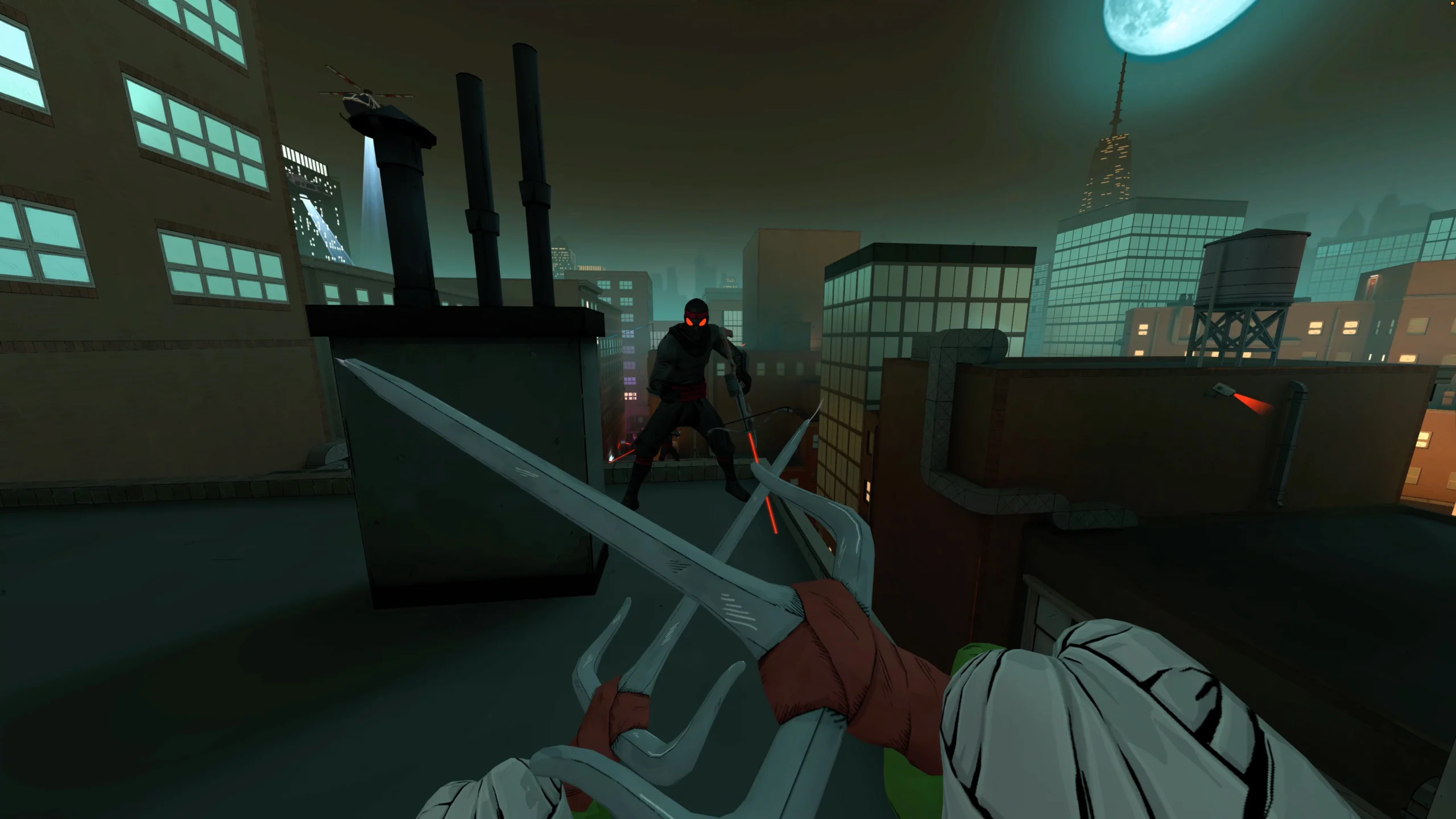
The co-op gameplay significantly enhances the experience. Playing alongside up to three others alters the flow of combat, making encounters more chaotic and dynamic in a positive way. Coordinating attacks or simply providing cover for each other during fights introduces a layer of teamwork that the solo mode lacks. That said, the gameplay doesn’t change drastically in co-op—it’s more of an extension of the same systems rather than a complete overhaul.
The essence of the gameplay lies in its ability to immerse players in the fantasy of being a Ninja Turtle. The combat’s physicality, the vertical movement, and the ongoing focus on agility combine to forge a robust sense of identity. Although it occasionally falls short of its full potential due to some repetition and slight control problems, the fundamental mechanics remain strong and enjoyable. As a VR experience, it achieves a commendable balance between being user-friendly and having depth, allowing for easy entry while still providing enough complexity to keep players engaged over time.
Stylish Visuals Shine
The visual presentation in Teenage Mutant Ninja Turtles: Empire City stands out as one of its most compelling and immediately eye-catching features. The game employs a striking, cel-shaded comic book aesthetic, characterised by bold outlines and deep shadows that create the sensation of stepping right into a graphic novel. This artistic choice aligns seamlessly with the TMNT universe, providing environments and characters with a lively, stylised appearance that performs admirably in VR. At its finest, the world resembles a “living comic book,” with hand-drawn textures and pronounced lighting that enhance the immersive experience.
However, the visuals do have their shortcomings. Although the art direction is consistently attractive, technical limitations can occasionally disrupt the illusion. Some environments may lack diversity, and certain animations might seem a bit jittery or unfinished, which becomes more apparent during prolonged gameplay. There are also minor visual hiccups—such as floating objects or clipping issues—that serve as reminders of the game’s limitations. Nevertheless, the unified art style does a significant amount of work, ensuring that the game remains visually captivating even when the finer details aren’t always state-of-the-art.
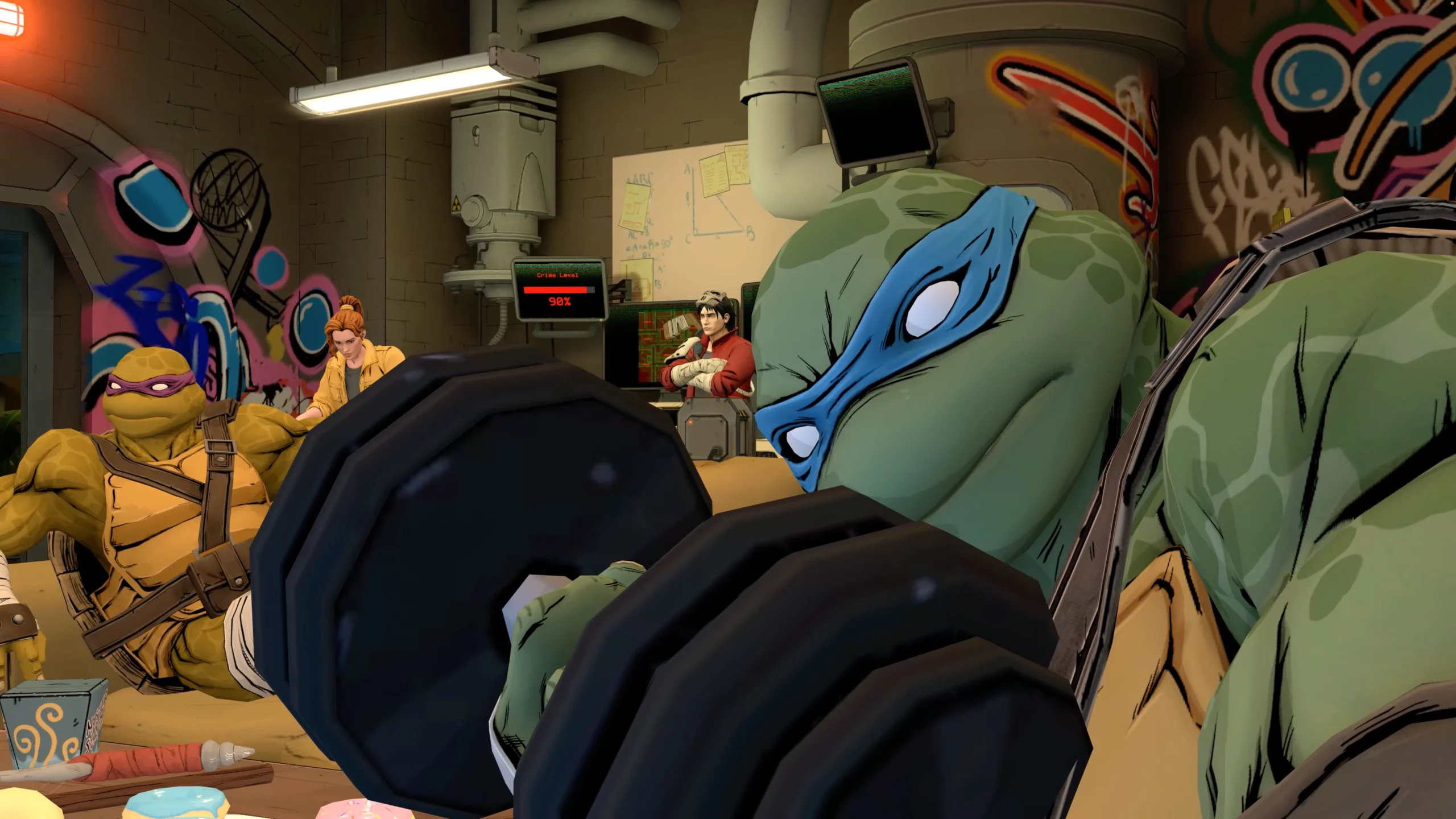
The sound design is competent but not as remarkable as the visuals. The combat audio is where it truly excels, featuring satisfying impacts and weapon sounds that lend a sense of weight and realism to the fights. The voice acting is generally strong, effectively capturing the personalities of the turtles and their supporting characters, although it can sometimes come across as a bit repetitive during extended play.
The soundtrack, on the other hand, is somewhat of a mixed experience. While the music during boss fights injects energy and enhances pivotal moments, the rest of the score tends to blend into the background without making a significant impact. Exploration themes can become monotonous, and some voice lines are reused frequently enough to be perceived negatively. Overall, the audio performs adequately, but unlike the visuals, it seldom elevates the experience beyond its basic function.
Comfort
| Posture | Supported |
|---|---|
| Standing mode | Yes |
| Seated Mode | Yes |
| Artificial Crouch | Yes |
| Real Crouch | Yes |
| Movement | Supported |
| Smooth Locomotion | Yes |
| - Adjustable Speed | No |
| Teleport | No |
| Blinders/Vignette | Yes |
| - Adjustable Strength | No |
| Head-based | Yes |
| Controller-based | No |
| Dominant Hand Switcher | No |
| Turning | Supported |
| Smooth Turning | Yes |
| - Adjustable Speed | Yes |
| Snap Turning | Yes |
| - Adjustable increments | Yes |
| Input | Supported |
| Tracked Controllers | Yes |
| Hand Tracking | No |
| Gamepad | No |
Verdict

Teenage Mutant Ninja Turtles: Empire City offers a bold and engaging VR experience that perfectly captures the thrill of being a Ninja Turtle. The most compelling aspects are the satisfying motion-based combat and smooth parkour movements. While the narrative serves as a solid foundation, it’s the gameplay and stylish comic-book aesthetics that elevate the experience, despite some technical issues and repetitive encounters preventing it from reaching its full potential. The co-op mode introduces enjoyable chaos without overhauling the fundamental mechanics, and while the audio design is adequate—with impactful combat sounds and decent voice acting—the soundtrack falls short of making a strong impression. In summary, it’s a highly entertaining VR game with a distinct identity and vibrant energy.
Release Date: April 30th 2026
Developer: Cortopia Studios
Publisher: Beyond Frames Entertainment
Price: £19.99 / US $24.99
Reviewed On: Meta Quest 3
* Access Provided For Review *
Advertisment
Advertisment

Advertisment

Advertisment

Advertisment
Copyright / Virtual Grip (formally The VR Realm) / 2016 -