
Listen to The VRverse Podcast

Advertisement

Looxid Link Review - Versatile applications highlight significant technological potential
- April 30, 2020
- 12:39 pm
We are constantly eager to explore how new hardware can enhance the VR experience, and the Looxid Link has certainly piqued our interest for this very reason. The team at Looxid Labs employs EEG (electroencephalogram) technology to enable users to control elements in VR using their brain. After putting this technology to the test, what were our impressions?
What's In The Box?
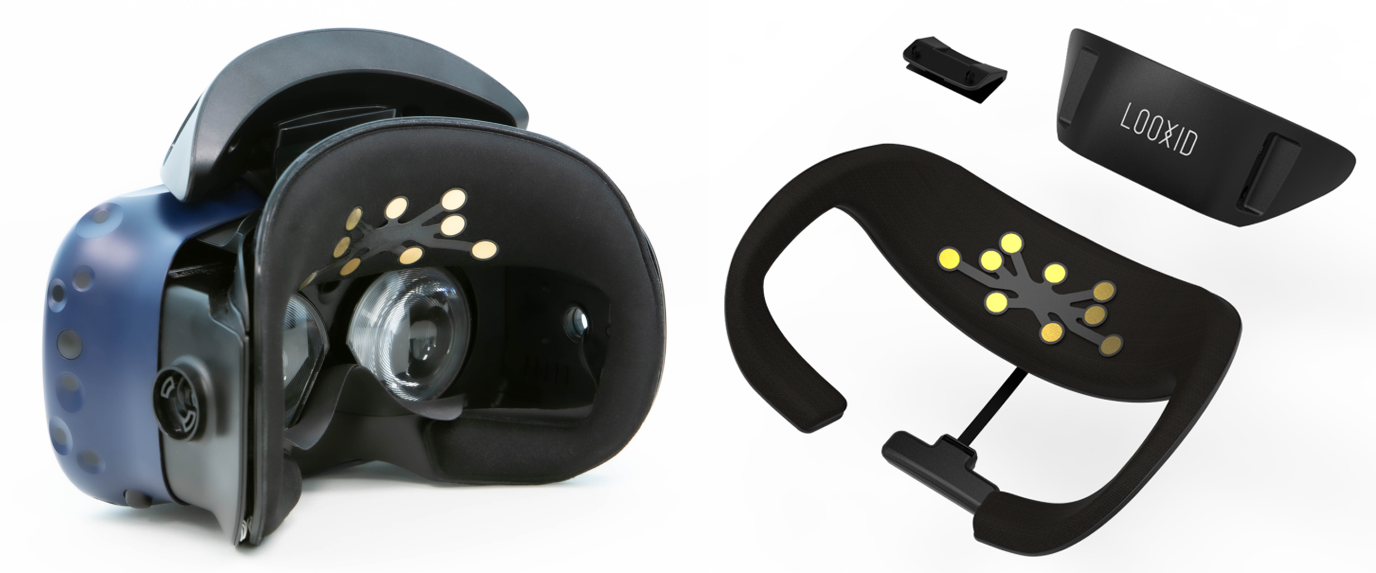
Inside the box, you’ll find a Link Hub, a USB-C to Micro-USB cable, a plastic mount designed to attach the Link Hub to your Head Mounted Display (HMD), and a face gasket equipped with EEG sensors to replace your existing face gasket.
Installation
You might assume that this type of technology would require a long installation process, but I was able to assemble the product on my HMD in just about six to seven minutes.
Assembly
1 – Begin by removing the existing face gasket and inserting the USB-C end of the cable into the port located behind the gasket frame.
2 – Next, attach the mount by extending the front of the HMD to its maximum using the adjustment button. Slide the mount into place, then adjust it back to your preferred position.
3 – After that, position the provided face gasket with the sensors facing outward. This process is similar to installing any face gasket; just ensure everything is aligned correctly. Before securing it, make sure to thread the magnetic charger through the gap at the top of the HMD.
4 – Connect the magnetic charger on the face gasket to the port on the Link Hub, and then link the Link Hub to the mount you installed in step 2.
5 – Finally, connect the Micro-USB to the port on the side of the Link Hub, and your setup will be complete.
To ensure everything is connected correctly, start by powering on your HMD and toggling the power switch located on the side of the Link Hub. If all connections are secure, a green light will appear.
Once this is set up, the next step is to install the Link Core software on your PC, which is a quick process. Simply visit their website’s Store, add the free Looxid Link Core Application to your cart, and proceed to checkout (you can also include the Demos during this process).
The Looxid Link
The build quality of the Link Hub is great, they’ve used a high quality plastic on the mould and it is all fit together nicely. One thing we were worried about when first learning of the product was would the Link Hub have some weight to it that might cause issues with comfort and weight distribution, but even from picking up the box with everything in it we could see how light weight it actually was.
The face gasket fabric is made out of polycarbonate, knit fabric and polyurethane sponge, which is attached to more quality plastic with Velcro on for the face gasket frame on the Vive Pro. The fabric and sponge used makes it all very comfortable on your face while in use and feels very similar to the foam mounted at the back of the HTC Vive Pro for the extra comfort for the HMD.
Attached to the gasket you have 6 EEG channels, which are monitored by dry electrodes on flexible PCB. This was another thing that had us worried on first seeing the product, with thinking would these electrodes be comfortable against your head when in use. But, after hours of use with the product we have not felt any discomfort from them or even had any moments when it was obvious they were even on the face gasket.
So, when it comes the product itself we have no issues with the quality of the build, and any of my main worries about the device were soon answered in a positive manner.
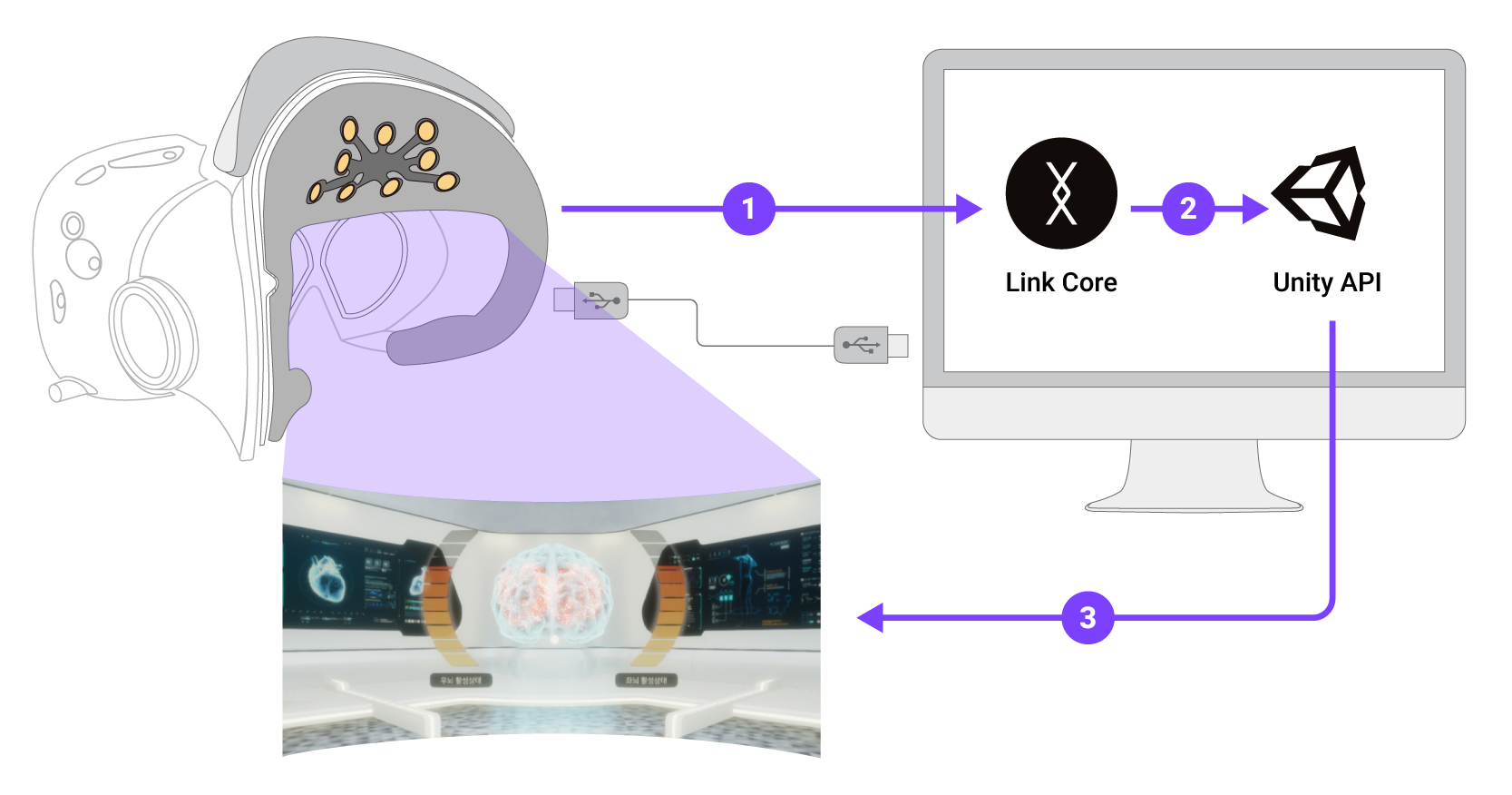
Testing The Product
To begin with, before exploring applications beyond the 2D and 3D visualizers, we highly recommend starting with the 3D visualizer, as it fully utilizes the VR space. This suggestion stems from the need to ensure that the EEG sensors experience minimal noise for optimal technology performance. If you notice elevated readings, as I did during my initial experience, there are straightforward steps you can take to enhance these readings. They are as follows:
1 – Clean your head and sensors thoroughly, as any dirt or particles can interfere with sensor accuracy.
2 – Ensure that the face gasket and the HMD are positioned correctly and not at any angle.
Using these significantly reduced the noise during our initial reading, which had been displaying a message indicating Noise Detected on Sensors. Once we adjusted everything correctly (which may require some testing), we discovered that the Noise Detected alert only appeared when we spoke while using the product, caused by forehead movement during speech.
Following this, we explored the three applications available for the Looxid Link on the Looxid Labs website, which demonstrate how the technology can be applied in various ways.
We highly recommend starting with VR Mind Care, which guides you through meditation techniques focused on breathing and relaxation. The application utilizes EEG technology to assess your performance at each stage of the five-minute exercise, providing feedback on whether you are Balanced or Unbalanced. Throughout our testing period, we have been using this application daily for a five-minute relaxation session through meditation, and we are noticing improvements in our performance and readings. We suggest this application first because it offers a solid understanding of how the sensors and product function, which is beneficial for the two more interactive applications.
Next, we have two applications that enable you to manipulate objects with your mind, namely Interaction Playground and our favorite, Mind Master: Pyrokinesis.
In the Interaction Playground, you’ll harness your focus and relaxation to manipulate blocks within the application. These blocks are positioned in front of you or scattered around the environment, which you can navigate by teleporting. The more attention you give, the higher these blocks will ascend towards the ceiling, as if gravity has been disabled in the room. Conversely, when you relax, the blocks will descend to the floor. This illustrates how the sensors utilize your brain activity to gauge your level of attention.
Next is Mind Master: Pyrokinesis, a mini-game where you battle a dragon using fireballs in virtual reality. In this game, focusing on the fireball is crucial; the more attention you provide, the larger the fireball becomes, inflicting greater damage on the dragon. You’ll use your controller to grasp the fireball, aim with your headset, and then throw it with a motion. The screen displays a heads-up display (HUD) showing both the dragon’s health and your own, represented by three hearts. If the dragon’s fireball strikes you, you’ll lose a heart, which you can avoid by moving within your play space. At the end of the game, a top ten leaderboard appears, allowing you to challenge friends and family to beat your scores.
These applications have been developed by the team at Looxid Labs. Aside from the initial testing phase to reduce sensor noise, we have not encountered any performance issues with the device. We eagerly anticipate what further innovations the team at Looxid Labs and other developers will bring to this technology.
If you have an interest in Unity and the skills to create applications for the Looxid Link, a Unity SDK is available on GitHub.
Cost
Given the advanced technology utilised in the Looxid Link, it’s no surprise that it comes with a price tag. However, considering the product’s capabilities and the technology it incorporates, we believe it is reasonably priced. That said, for many VR enthusiasts, the $299 cost could represent a significant investment to make all at once.
Verdict
During our initial exploration of the Looxid Link, we were eager to delve into its technology and discover its capabilities. Although we had some concerns regarding the device’s weight and overall comfort, these were quickly resolved during our testing phase. As we began to experiment with the product and familiarize ourselves with its sensors, we enjoyed maximizing its performance through various applications. One application introduced me to the advantages of mental wellness through meditation, while others allowed users to interact with objects in the app using their thoughts, showcasing the technology’s potential within the medium. However, a significant challenge lies ahead: the long-term success and sustainability of the Looxid Link will largely depend on the continued adoption of this technology by Looxid Labs, as well as other companies and developers. We sincerely hope this goal is realized, as even the five applications currently offered by Looxid Labs demonstrate the potential for numerous uses in the VR space.

Advertisment

Advertisment

Advertisment

Advertisment

Advertisment
Copyright / Virtual Grip (formally The VR Realm) / 2016 -